
Freedom, pauses and spectral jellyfish
The real joy of Sounds of the New, for me, has been the chance to work in close contact with the six composers. We’ve been in dialogue since the start of the project and at various points since then, and it’s been a real privilege to see how the pieces grow from initial ideas into full scores, and then to be involved in turning them into music.
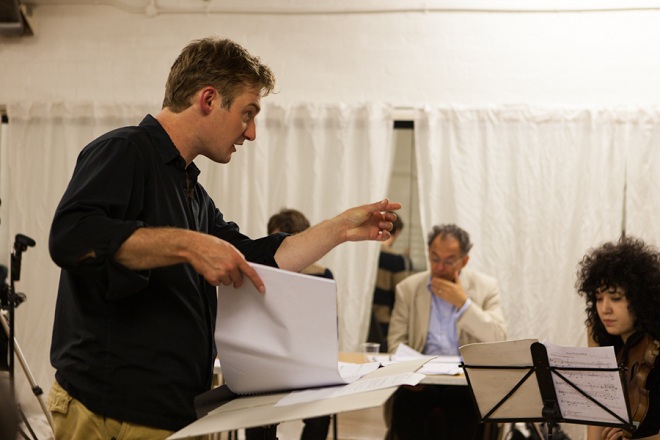
In the initial discussions with New Dots, we decided to have the workshops well in advance of the final concert, so that having seen and heard the ACTual people playing their ACTual instruments, there was still time for significant changes to be made if required. Happily, this seems to have been really beneficial – in some cases, composers have actually changed instrumentation, tightened their structure or extended sections of the piece, rather than just agreeing to mark, say, the clarinet part up to mp after all (!), …………………………………………………… or reluctantly agreeing to having the full 5 seconds on that pause.
Over the course of the project the questions asked by the composers, and the words used to ask them has evolved – for one, the initial question was about whether or not the players were ‘theatrical people’…. months later we were talking ‘spectral jellyfish’, ‘bubbles’, ‘bangs’ and ‘pillars’, and drawing shapes on serviettes. For another, the genesis of the piece was playing with freedom and control, and over time our conversation grew into a discussion of patterns of growth, line and direction. The value of this for a performer? Beyond sorting out any technical issues, it helps determine an attitude towards the piece and consequently, an approach to performing it.
In the workshops themselves the room was full of perspectives on the pieces, and it was great to discover them as they arose. Using the benefit of their experience and knowledge of their instruments, players asked questions and/or suggest alternatives to composers if things were unnecessarily impractical, or if effects could be intensified; similarly, composers had the opportunity to try different approaches to their material, to explain their thinking, and to push for any extra-detailed nuances. It was a really constructive, interactive day, and we’re grateful to Sinan Savaskan for chairing the sessions – to have the advice of someone of his breadth and depth of experience was invaluable indeed.
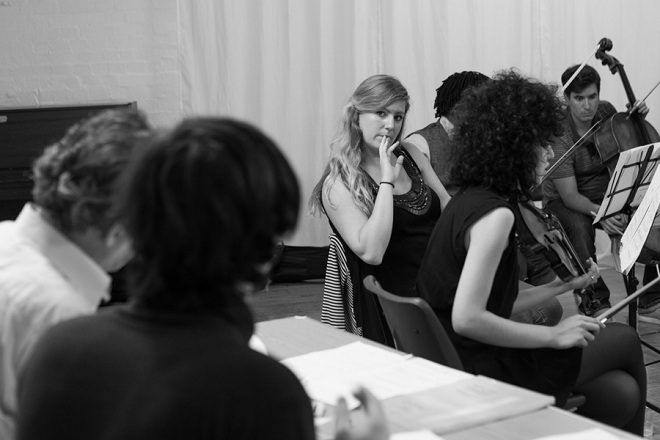
The programme offers a chance to hear a diversity of approaches to this ensemble– each composer does something really distinctive with the group. I’ve been asked to write a few ‘tasting notes’, introducing the pieces. Describing music with words is always difficult, but hopefully this will whet your appetite. Come to Camden on 14th November, and see how the programme suits your taste (spectral jellyfish, anyone?).
Patrick Jones’s piece ,Meet, Lock and Race is based on the idea of water moving within a river. As the music twists and turns in and out of knots, patterns of eruption and dissipation of energy meet with, flow through and divide around more static chords as the tides recede. Effectively, the question of the piece is which direction the music will take next.
Nick Morrish Rarity’s Patina also plays on changes in energy level, although here the fascination lies in the rate at which energy buildsup, and also, whereabouts in the ensemble – the piece is about oxidization which, (I seem to remember from GCSE Science) incorporates rusting through to explosion, with respiration somewhere in between….
Gamma by Kristoffer To navigates the edges of the palette of sounds available from each instrument individually, as well as from the ensemble as a whole. Some really unique timbres here – a real exploration of colour!
Maxim Boon’s new piece Sailing Stones is a personal account of recovery from pneumonia. He also draws a broad range of sounds out of the ensemble, including whispered syllables and phonemes. Well-paced management of textures helps the ensemble to breathe - and at times, in line with the inspiration for the piece, to struggle to.
In Duo Music by Sam Messer, crystalline textures shift in an intensely focused soundworld built out of tiny musical cells. The restrictions Sam places on his material adds to the expressivity of the piece, amplifying minute details – tiny changes here take on far greater significance than they would in other contexts.
As in many of his pieces, in Slices, William Cheshire simply presents a succession of sounds/chords. For me, the ‘passive’ fascination here lies in becoming absorbed – this is music that happens to you, rather than vice versa. So, how to describe the piece?....
Bold. Quiet. Colour. Objective. Distinctive. Joyous?. Harmony? (If you hear it). Beautiful. Warm. Static. Meditative. Exciting. Cool. Quiet. Sad? Slow. Serene. Personal. Communal.
The concert at The Forge on Thursday 14th November marks the culmination of a wonderfully collaborative process, made possible by everyone at New Dots. Bravo to them, and let’s have a good night!
Tickets for the concert on 14th November are available from the Forge website
Jon Hargreaves is a conductor, arranger, composer and music educator. He conducts and co-directs The Octandre Ensemble, and teaches in the Junior department at Trinity Laban.
Categories
- Events
- Concert
- Interview
- Composer
- Musician
- Audience Review
- Birthday
- Competition
- workshop
- collaboration
- conductor
Archive
Tweet Feed
-

RT @Londonist: Hear six world premieres at Sounds of the New gig @TheForgeCamden http://t.co/rTsUYve0nC
Tuesday 12 Nov 13